
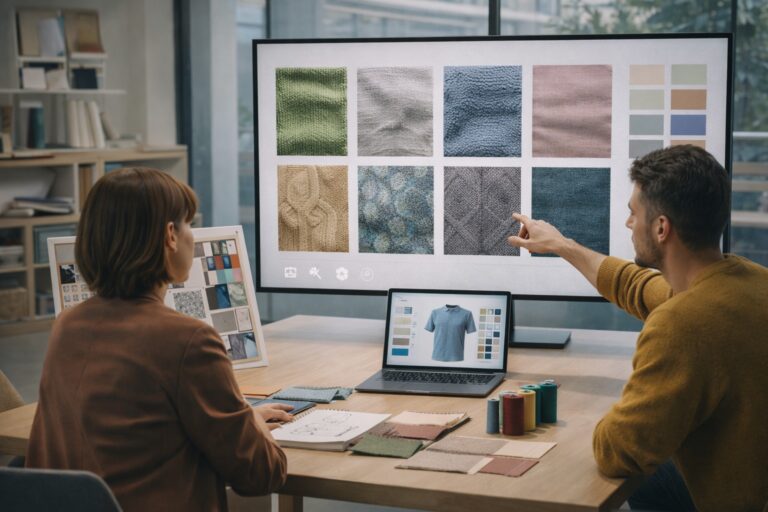
The textile sourcing landscape is evolving fast. In 2026, it won’t be just about finding a reliable supplier or a quality fabric — it will be about reinventing the entire model: more digital, more collaborative, more transparent.
So, what’s coming next? What tools, methods and expectations will shape the future of the industry?
Here are the 6 major trends every fashion and textile professional should watch.
1. Sourcing gets visual (and immersive)
No more static catalogs or unreadable spec sheets. Today’s professionals want to see, test, configure — before even starting a conversation.
Digital showrooms, 3D configurators and immersive experiences are becoming the new standard, especially during early-stage sourcing. They save time, reduce sampling and make sourcing more intuitive and efficient.
In 2026, textiles will be seen, explored, and validated — all on screen.
2. Physical prototypes become the exception
Environmental pressure, logistics costs and speed-to-market all push toward a big shift: going digital-first.
Thanks to 3D design, real-time customization and generative AI, products can now be simulated with astonishing realism — and validated without ever producing a physical sample.
This not only improves agility, but significantly lowers environmental impact.
3. Transparency becomes a competitive edge
With new EU regulations like the Green Deal, Digital Product Passport, and CSRD, traceability is no longer optional — it’s mandatory.
But it goes beyond compliance. Today, origin, sustainability and production ethics are key selling points. Buyers want proof, not promises.
Platforms that enable clear and verified data sharing will lead the way.
4. “One-size-fits-all” is dead
Every brand is unique. Every factory has its own DNA. In 2026, rigid tools won’t cut it anymore.
What’s rising instead? Modular, headless, and customizable B2B marketplaces. These platforms don’t force a one-size-fits-all approach. They adapt to each player, enabling tailor-made workflows.
Customization isn’t just for clothing anymore — it’s for sourcing tools too.
5. Data drives every decision
Which fabric got the most views? Which print was configured most? Which color was dropped?
In 2026, sourcing decisions will be powered by real-time data — not gut feeling.
User behavior, performance analytics, smart dashboards: data will help brands and manufacturers act faster, smarter and with greater precision.
6. Sourcing goes collaborative
What if sourcing wasn’t a solo task anymore?
The future belongs to collaborative platforms, where brands, designers and factories co-create products in real time.
The interface becomes a conversation space. The end product is the result of continuous feedback loops. This new way of working will become the norm in agile ecosystems.
In a nutshell
Sourcing in 2026 will be: more immersive, faster, more transparent, fully modular, data-driven, collaborative by design.
This transformation is already underway — and it’s changing how the entire European textile value chain operates.
Curious how to future-proof your sourcing? Book a demo and discover the platform that brings these trends to life.
6 trends that will reshape textile sourcing in 2026
Discover the 6 key trends that will transform textile sourcing in 2026...
Read moreTop 5 digital innovations transforming the textile industry in 2025

Digital transformation is reshaping the textile industry. From AI-driven design to immersive...
Read moreS2G XR awarded the Innovation Label at the IAKA Fair in Namur
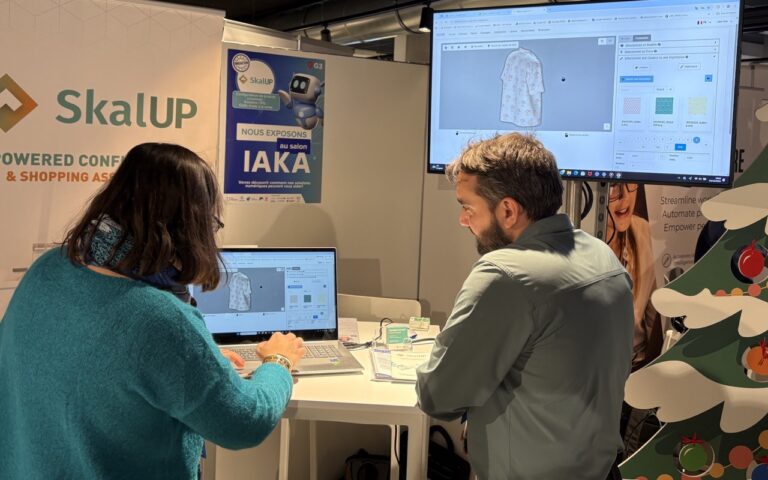
Awarded at IAKA Fair in Namur, S2G XR receives the Innovation Label...
Read moreWhy European fashion needs more transparent sourcing
A showroom that converts is more than digital — it’s strategic. Discover...
Read more